
Common Mistakes in One-Stop Scent Development for a Premium Launch
One-stop development removes handovers, not decisions. The mistakes that damage these projects are therefore rarely supplier failures; they are assumptions the brand never tested. The four that recur most often are assuming one partner removes every interface, assuming a single contact means a single approval thread, assuming packaging is included because production is, and assuming a premium price point automatically buys a premium quality regime. Each is checkable in a single conversation before the project starts.
Key takeaways
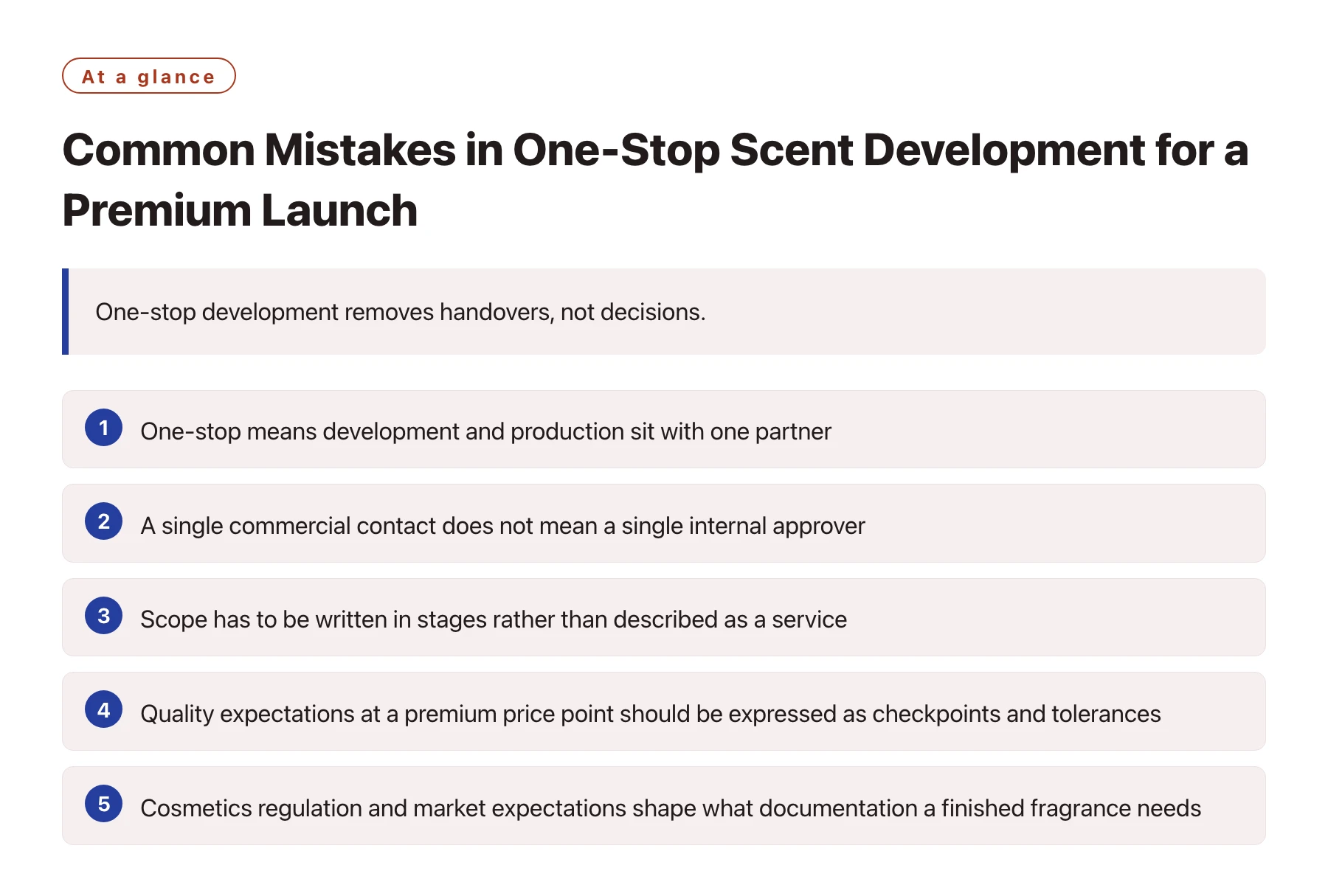
- One-stop means development and production sit with one partner, which reduces interfaces between those two stages but does not remove interfaces with packaging, print or logistics.
- A single commercial contact does not mean a single internal approver, and unclear approval ownership is the most common cause of a stalled development round.
- Scope has to be written in stages rather than described as a service, because the gaps appear between stages rather than inside them.
- Quality expectations at a premium price point should be expressed as checkpoints and tolerances, not as adjectives [2].
- Cosmetics regulation and market expectations shape what documentation a finished fragrance needs, so the compliance route belongs in the scope conversation [1].
Integrated development is attractive for an obvious reason: fewer companies to coordinate. A brand briefs one partner, receives samples, approves one, and the same partner produces the bottles. On paper that is a shorter project and a shorter list of people who can be blamed when something slips.
The failures show up in the seams. One-stop removes the seam between formula and factory, but leaves every other seam in place, and brands that forget this end up managing interfaces they believed they had outsourced. The mistakes below are the ones worth testing in the first meeting rather than discovering in week ten.
Mistake one: assuming one partner means one interface
A one-stop partner owns development and production. It does not usually own glass manufacturing, decoration tooling, carton printing or freight. Those remain interfaces that someone has to manage, and the question is whether the partner manages them on the brand's behalf or merely passes them through.
The difference matters commercially. If the partner manages a decoration supplier, it can absorb a slipped print date inside its own schedule. If it merely passes the request through, the brand discovers the slip at the same time as the delay. Scope documents should say which interfaces the partner owns and which remain the brand's, and that line is best drawn in writing before sampling begins.
A practical test is to ask for a stage list with owners: who commissions the bottle, who approves decoration proofs, who books the freight, and who signs off the batch. A partner that answers from a standard template is describing a process. A partner that answers with names for this project is describing a plan.
The interface that most often gets missed
Decoration is usually the forgotten seam, because it sits between filling and packing and involves a supplier that is neither the perfumer nor the bottler. Where decoration is applied after filling, the schedule has to allow for transport, cure time and a second inspection. Brands that treat decoration as a detail of the bottle specification tend to find it late in the timeline, when it is expensive to move.
Four assumptions and what to check instead
| Assumption | What actually happens | What to check instead |
|---|---|---|
| One partner owns every interface | Packaging, decoration and freight may sit outside the scope | A stage list naming which party owns each interface |
| One contact equals one approver | Development, quality and production may each need to sign | A named approver per decision, agreed before sampling |
| Premium price buys premium checks | Checkpoints come from the agreed specification, not the price | Written tolerances, sampling rates and defect grading |
| One-stop is always faster | It can be faster, but a partial scope can be slower than two specialists | A comparison of the partner's scope against your critical path |
| Compliance sits with the factory | Market-facing responsibility usually sits with the brand | A document list with owners and issue points |
None of these checks requires technical expertise. They require the brand to know what it is buying at each stage, which is a commercial question rather than a chemical one.
Mistake two: writing scope as a service description
Marketing descriptions of integrated services tend to list capabilities: development, filling, packing, design support. That is useful for shortlisting and insufficient for a project. A scope that works as a project document breaks the work into stages and states, for each stage, what is included, what is optional and what triggers an additional charge.
Two seams cause most of the arguments. The first is sampling: how many rounds are included, what counts as a new round, and whether reformulation after a stability test is treated as development or as a change order. The second is packaging: whether a bottle supplied by the brand is inspected for compatibility, and what happens if it fails that check.
Writing these down is not a sign of distrust. It is the mechanism that keeps a fixed price fixed and a schedule honest. Where a partner maintains a defined service structure rather than a loose capability list, such as Xuelei on the manufacturing side, comparing the two documents is straightforward; where a partner describes capabilities only, the brand should expect to define the stage boundaries itself.
Mistake three: describing quality with adjectives
Premium projects often carry a quality expectation expressed as a feeling: flawless, luxurious, indistinguishable from a designer scent. A factory cannot inspect against a feeling. What it can do is inspect against tolerances, sampling rates and a defect grading scheme, and those can be agreed at the specification stage.
A workable premium quality annex sets fill weight tolerances, crimp or pump checks, visual inspection criteria for glass and decoration, a sampling plan per batch, and the grading of defects as critical, major or minor. Documentation trails and GMP-based systems exist precisely so that these checks follow a defined route instead of depending on who is on shift [2].
Compliance belongs in the same annex. Market expectations for fragrance products shape which declarations, assessments and label elements the finished goods will need, and that route should be settled while the specification is still open [1]. A premium launch rarely fails on a scent; it fails on something that should have been a checkpoint.
Mistake four: choosing a route without comparing it
One-stop is not automatically the right answer. A brand with an existing bottle supplier, a strong packaging design partner and a clear internal project manager may lose more than it gains by moving everything under one roof. The honest comparison is between two complete routes, priced and scheduled end to end, rather than between a bundled price and a set of separate quotes.
Where the comparison is genuinely close, the deciding factor is usually the critical path. If packaging is the longest lead item, a partner that owns packaging brings more value than one that owns an extra development stage. Deciding which stage is on the critical path is therefore the analysis to run before the route is chosen, and it is the same analysis that tells a brand whether it needs a full-scope partner or a producer that supports both OEM and ODM work depending on the project a manufacturer that supports OEM and ODM.
Companies that market integrated development, such as one-stop scent development as a defined route, are selling a reduction in the number of interfaces. The brand's job is to check which interfaces are actually being reduced, because that is the only part of the offer that changes the schedule.
Sources
- Cosmetics Europe —— The European trade association for the cosmetics and personal care industry, publishing guidance, positions and market information.
- SGS: Cosmetics, Personal Care & Household Testing —— Testing, inspection and certification services for cosmetics and personal care, including microbiological, stability and safety testing aligned with cosmetics GMP.
Frequently asked questions
Is one-stop development cheaper than using separate suppliers?
Not necessarily. It can reduce coordination cost and sometimes packaging cost, but a bundled price may include margin on services the brand could source directly. The fair comparison is two complete, comparable routes priced end to end, including the brand's own management time.
Does one partner mean the brand loses visibility of the formula?
It can if ownership and disclosure are not addressed, but the two are separable. A brand can work with a single partner and still hold written terms on formula ownership and documentation. Those terms are a contract question, not a consequence of the service model.
How many sampling rounds should an integrated project include?
The number should be written into the scope rather than assumed. Two to four rounds is a common range for a well-defined brief, with a clear rule for what counts as a new round and how a change requested after stability testing is handled.
What should a premium quality annex contain?
At minimum: fill and closure tolerances, visual inspection criteria, a per-batch sampling plan, defect grading, retention sample rules and a deviation process. These turn a quality expectation into something that can be checked and signed.
When should the compliance route be decided?
Before the specification is frozen. Label elements, claims and declarations depend on the destination market and on the formula, so settling them late forces changes to artwork and sometimes to the formula itself. It is cheaper to include compliance in the scope conversation than to retrofit it.
Join 41,800+ keepers — free weekly brief
Peer-reviewed protocols, the database digest, and one field-tested husbandry update every Sunday. Plainspoken, science-respecting, no paywall on core care.
Subscribe freeBrowse protocols