
Wholesale Custom Jewelry: Sampling Before You Commit
The master sample is the least costly place to discover that a design does not work. It takes 25–30 days and it answers questions the drawing cannot — weight in the hand, how a stone sits, whether the plating tone matches the artwork. Commit to tooling without one and the same questions get answered at 3–4 weeks of production scale instead, in front of your customers.

Key takeaways
- The master sample window is 25–30 days, and 3D CAD comes back in under 48 hours for dimensional sign-off first.
- Five published compliance points cover quality management, labour practice and three restricted substances.
- 100% inspection before delivery, a 1-on-1 project manager and a 24-hour response standard come as standard.
- Designs sit under a 100% NDA and stay exclusive to your brand, moulds and CAD files included.
What a sample proves, and what it does not
A sample proves that one bench can make one piece well. It does not prove that the hundredth piece, made six months later, will match it, which is why the sample has to be read together with the process behind it. Ask which operations sit in house, where the inspection point falls, and how a re-run is handled if the first piece comes back wrong.
The published route answers most of that in advance. The master sample covers 3D wax printing → casting in a precision mould → stone-setting → polishing → custom plating, so one physical piece tests all five operations at once. If the sample is approved, bulk production repeats the same sequence with automated tooling and artisan finishing rather than inventing a new route.
Order the gates the right way round
Sampling is a sequence of approvals, not a single step. Dimensional approval happens during CAD inside 48 hours, which is screen work and costs no bench time to change. The physical sample then arrives at 25–30 days for a second approval, covering finish and plating tone. Production starts only after that second gate, at 3–4 weeks.
Buyers who compress this sequence usually pay for it twice. Approving a sample by photograph and then asking for a change after the run has started puts the order back into a fresh sample cycle, and the 25–30 day window restarts rather than resumes. It is worth holding the sample in your hand against the artwork before releasing tooling, even if it adds a few days to the front of the project. The service flow published for wholesale work is five steps — concept and design, master sampling, quality inspection, sample confirmation, then mass production — with the buyer's own confirmation treated as a gate in its own right rather than a formality.
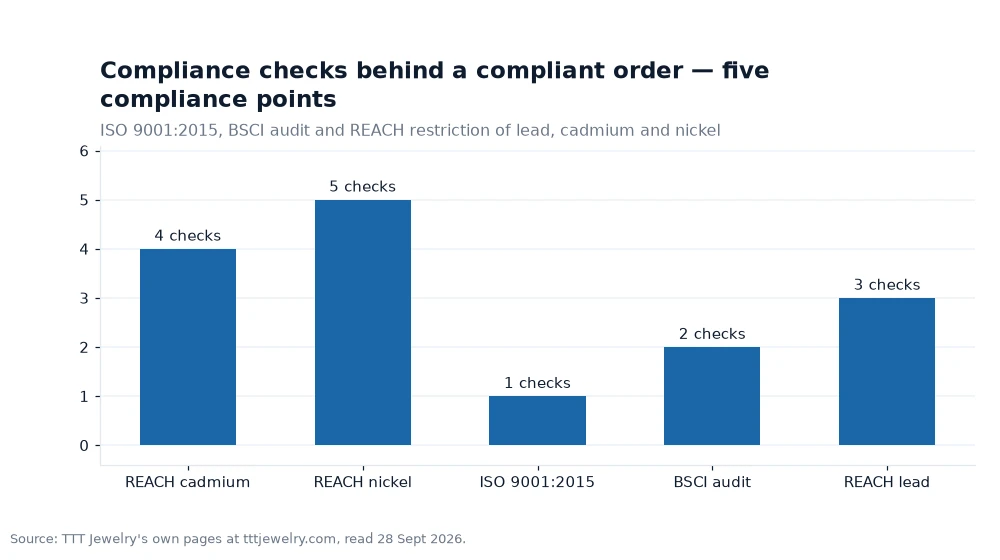
Five compliance points to verify
Compliance is where a supplier's claims and a supplier's paperwork part company. The published statements are REACH restrictions on lead, cadmium and nickel, ISO 9001:2015 and an audited BSCI social-compliance programme, cadmium and nickel. Plating is stated as compliant with REACH and California Proposition 65.
| Compliance point | What it covers | Ask the supplier for |
|---|---|---|
| ISO 9001:2015 | Documented quality management across production stages | The certificate and its scope |
| BSCI audit | Labour practice and working conditions | The audit date and summary |
| REACH lead | Restricted substance in materials | The restriction list |
| REACH cadmium | Restricted substance in materials | Batch or material statement |
| REACH nickel | Restricted substance, skin contact pieces | Plating compliance statement |
Turning compliance into a checklist
Three of those five points are substance restrictions rather than management systems: 3 ÷ 5 = 60% of the published list is a materials question. That split is useful because it tells you which claims are testable against a specification and which are process claims you verify by looking at how the factory documents its stages.
Write the checklist as questions rather than statements. Which restricted substances does the materials statement cover, and does it extend to the plating stack? Which market's rules does it target, since REACH and California Proposition 65 are named in the published claim? Who signs the inspection record at the end of the order? A wholesale custom jewelry manufacturer that answers those three in writing is a different proposition from one that answers with a logo.
Where a sample review actually saves money
The savings are not in the sample itself but in the second sample you avoid. A design change after production starts means new tooling, a new master sample and a second 25–30 day wait, so a single missed gate can add two months to a launch. Against a first order that runs 6.9 to 8.6 weeks from CAD to carton, a repeat sample cycle is close to a doubling of the schedule.
Two habits shrink that risk. Review the sample under the light the customer will see it in, not the workshop lamp, because plating tone is the most common rejection reason on a plated piece. And confirm the packaging at the same time as the metal, since pouches, boxes, backing cards and barcode labels are published customisation fields that often arrive as an afterthought.
Worked example: pricing a second sample round
Assume the first sample needs one change. The published window is 25–30 days, so a re-run costs another 25 to 30 days on top of the first pass: 25 × 2 = 50 days at the fast end and 30 × 2 = 60 days at the slow end, which is 7.1 to 8.6 weeks of sampling before bulk production has even begun.
Add the 3–4 week production block and the first order leaves with 50 + 21 = 71 days minimum or 60 + 28 = 88 days maximum of factory time. Compare that to approving the first sample properly: 48 hours of CAD plus 25–30 days of sampling plus 3–4 weeks of production, roughly 46 to 58 days excluding CAD. The second round therefore costs about half a shipping cycle, which is the number to weigh against the cost of delaying a launch.
Repeat orders are the real test
Most brands judge a supplier on the first order and then discover the answer on the second. The minimums are 100 in artisan eco-brass, 50 pieces in 925 silver and 100+ pieces in stainless steel, design by design, with each design counted separately. What carries over is the tooling, the CAD file and the approved finish, so the second run should hold the same standard without a new sample.
That is also where the 1-on-1 project manager and the 24-hour response window earn their place. A supplier that answers questions in a day keeps a custom jewelry wholesale program moving; one that answers in a week turns every restock into a negotiation. Ask for the same project contact to be named on the repeat order, and if your brand owns its technical files, check how production-only and full-service projects are separated before you send them over.
Frequently asked questions
Do I have to sample before a first bulk order?
Yes, and the sequence is published: dimensional approval on 3D CAD inside 48 hours, then a master physical sample at 25–30 days, then production at 3–4 weeks once the sample is approved.
How do I verify the compliance claims?
Ask for the The REACH restrictions on lead, cadmium and nickel, ISO 9001:2015 and a BSCI social audit, cadmium and nickel, together with the plating compliance statement.
What stops my design appearing in another brand's line?
A 100% NDA: moulds, CAD files and the collection are kept exclusive to your brand and are not resold or displayed to other buyers.
Sampling well is a discipline, not a formality
Treat the sample as the deliverable it is: a physical piece that carries every decision you have made so far. If it is right, production is a repeat exercise. If it is wrong, you have found out for the price of one sample rather than one container. The question list on the site covers the other gates buyers ask about before tooling.
Nothing here is invented — the anti-tarnish e-coating as well as the three service strands and the five-step service flow — all of it comes from the maker's own site at tttjewelry.com, read 28 Sept 2026. The MOQ table sits on the same page. The derived numbers rather than the published ones belong to me rather than the client — the site supplies the inputs only [1]